


Agile Is Dead, Long Live Agility
TL; DR: Why the Brand Failed While the Ideas Won
Your LinkedIn feed is full of it: Agile is dead. They’re right. And, at the same time, they’re entirely wrong.
The word is dead. The brand is almost toxic in many circles; check the usual subreddits. But the principles? They’re spreading faster than ever. They just dropped the name that became synonymous with consultants, certifications, transformation failures, and the enforcement of rituals.
You all know organizations that loudly rejected “Agile” and now quietly practice its core ideas more effectively than any companies running certified transformation programs. The brand failed. The ideas won.
So why are we still fighting about the label?
🗞 Shall I notify you about articles like this one? Awesome! You can sign up here for the ‘Food for Agile Thought’ newsletter and join 35,000-plus subscribers.
How Did We Get Here?
Let’s trace Agile’s trajectory: From 2001 to roughly 2010, Agile was a practitioner movement. Seventeen people wrote a one-page manifesto with four values and twelve principles. The ideas spread through communities of practice, conference hallways, and teams that tried things and shared what worked. The word meant something specific: adaptive, collaborative problem-solving over rigid planning and process compliance.
Then came corporate capture. From 2010 to 2018, enterprises discovered Agile and sought to adopt it at scale. Scaling frameworks emerged. Consultancies noticed new markets for their change management practices and built transformation practices. The word shifted: no longer a set of principles but a product to be purchased, a transformation to be managed, a maturity level to be assessed.
The final phase completed the inversion. The major credentialing bodies have now issued millions of certifications. “Agile coaches” who’ve never created software in complex environments advise teams on how to ship software, clinging to their tribe’s gospel. Transformation programs run for years without arriving anywhere.
The Manifesto warned against this: “Individuals and interactions over processes and tools.” The industry inverted it. Processes and tools became the product. (Admittedly, they are also easier to budget, procure, KPI, and track.)
The word “Agile” now triggers eye-rolls from practitioners who actually deliver. It signals incoming consultants, mandatory training, and new rituals that accomplish practically nothing that could not have been done otherwise.
The term didn’t become unsalvageable because the ideas failed. It became unsalvageable because the implementation industry hollowed it out.
Cannot see the form?
Please click here.
The Victory Nobody Talks About
However, the “Agile is dead” crowd stops too early. Yes, the brand is probably toxic by now. But look at what’s actually happening.
Look at startups that never adopted the terminology. They run rapid experiments, ship incrementally, learn from customers, and adapt continuously. Nobody calls it Agile. They call it “how we work.”
Look at enterprises that “moved past Agile” into product operating models. What do these models emphasize? Autonomous teams. Outcome orientation. Continuous discovery. Customer feedback loops. Iterative delivery.
Read that list again. Those are the Manifesto’s principles with a fresh coat of paint and, critically, without the baggage of failed transformation programs.
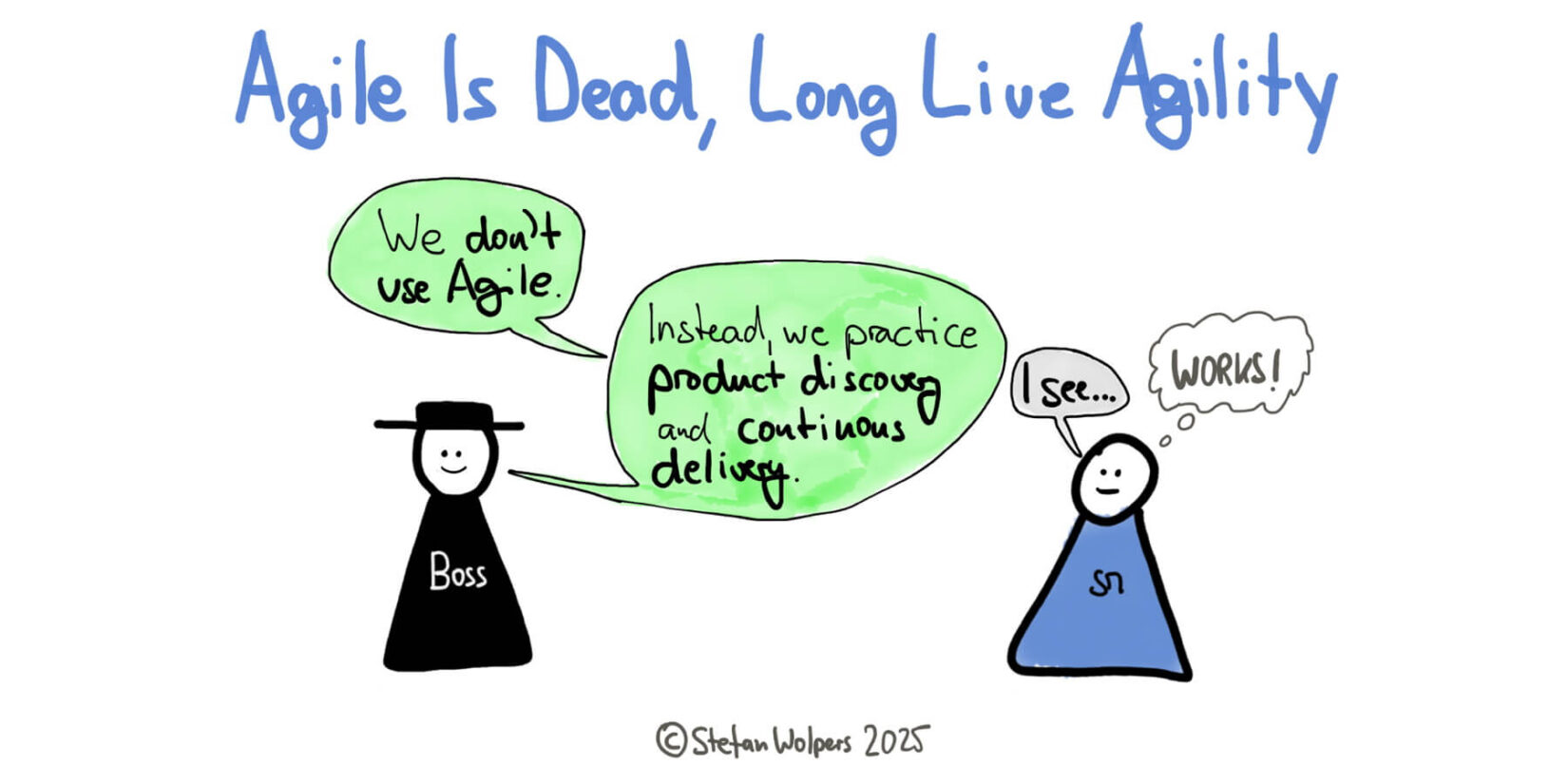
You can watch this happen in real time. A client told me this year, “We don’t do Agile anymore. We do product discovery and continuous delivery.” I asked what that looked like. He described Scrum without ever using the word. That organization is more agile than most “Agile transformations” I’ve seen.
And now AI accelerates this further. Pattern analysis surfaces customer insights faster. Vibe coding produces working prototypes in hours rather than weeks, dramatically compressing learning loops. Teams can test assumptions at speeds that would have seemed impossible five years ago.
None of this requires the word “Agile.” All of it embodies what the Agile Manifesto was actually about.
The principles won by shedding their label.
The Losing Battle
Some practitioners still fight to rehabilitate the term. They write articles explaining what “real Agile” means. They distinguish between “doing Agile” and “being Agile.” They insist that failed transformations weren’t really Agile at all, which reminds me of the old joke that “Communism did not fail; it has never been tried properly.”
At some point, if every implementation fails, the distinction between theory and practice stops mattering. This discussion is a losing battle. Worse, it’s the wrong battle.
When you fight for terminology, you fight for something that doesn’t matter. The goal was never the adoption of a word. The goal was to solve customer problems through adaptive, collaborative work. Suppose that is happening without the label? I would call it “mission accomplished.” If it’s not happening with the label, mission failed, regardless of how many certifications the organization purchased.
The energy spent defending “Agile” as a term could be spent actually helping teams deliver value. The debates about what counts as “true Agile” could be debates about what actually works in this specific context for this particular problem.
Language evolves. Words accumulate meaning through use, and sometimes that meaning becomes toxic. “Agile” joined “synergy,” “empowerment,” and “best practices” in the graveyard of terms that meant something important until they didn’t. Fighting to resurrect a word while the ideas thrive elsewhere is nostalgia masquerading as principle.
What Agile Is Dead Means for You
Stop defending “Agile” as a brand. Start demonstrating value through results.
This suggestion isn’t about abandoning the community you serve. Agile practitioners remain a real audience with real problems worth solving. The shift is about where you direct your energy. Defending the brand is a losing game. Helping practitioners deliver outcomes isn’t.
When leadership asks whether your team is “doing Scrum correctly,” redirect: “We’re delivering solutions customers use. Here’s what we learned this Sprint and what we’re changing based on that learning.”
When transformation programs demand compliance metrics, offer outcome metrics instead.
And accept this: the next generation of practitioners may never use the word “Agile.” They’ll talk about product operating models, continuous discovery, outcome-driven teams, and AI-assisted development. They’ll practice everything the Manifesto advocated without ever reading it.
That’s fine. The ideas won. The word was only ever a vehicle.
The Bottom Line
We were never paid to practice Agile.
Read that again.
No one paid us to practice Scrum, Kanban, SAFe, or any other framework. We were paid to solve our customers’ problems within given constraints while contributing to our organization’s sustainability.
If the label now obstructs that goal, discard the label. Keep the thinking.
Conclusion: Agile Is Dead, or the Question You’re Avoiding
If “Agile” disappeared from your vocabulary tomorrow, would your actual work change?
If not, you’ve already moved on. You’re already practicing the principles without needing the brand. You are already focusing on what matters.
So act like it: “Le roi est mort, vive le roi!”
What’s your take? Is there still something worth saving, or is it time to let the brand go? I’m genuinely curious.
📖 Agile Is Dead — Related Posts
From Mechanical Ceremonies to Agile Conversations
Why Agility Matters (And How to Break the Cycle When It Doesn’t)
Why Leaders Believe the Product Operating Model Will Succeed Where Agile Initiatives Failed
Agile Failure Patterns in Organizations 2.0
👆 Stefan Wolpers: The Scrum Anti-Patterns Guide (Amazon advertisement.)
📅 Scrum Training Classes, Workshops, and Events
Learn more about the Agile AI Manifesto with our AI and Scrum training classes, workshops, and events. You can secure your seat directly by following the corresponding link in the table below:
| Date | Class and Language | City | Price |
|---|---|---|---|
| 🖥 💯 🇩🇪 December 9-10, 2025 | GUARANTEED: Professional Scrum Product Owner Training (PSPO I; German; Live Virtual Class) | Live Virtual Class | €1.299 incl. 19% VAT |
| 🖥 💯 🇬🇧 January 29-February 19,2026 | GUARANTEED: AI for Agile BootCamp #5 — January 29-February 19,2026 (English; Live Virtual Cohort) | Live Virtual Cohort | €499 incl. 19% VAT |
| 🖥 🇩🇪 February 10-11, 2025 | Professional Scrum Product Owner Training (PSPO I; German; Live Virtual Class) | Live Virtual Class | €1.299 incl. 19% VAT |
| 🖥 🇬🇧 March 10-11, 2026 | Professional Scrum Master—Advanced Training (PSM II; English; Live Virtual Class) | Live Virtual Class | €1299 incl. 19% VAT |
| 🖥 🇩🇪 March 24-25, 2025 | Professional Scrum Product Owner Training (PSPO I; German; Live Virtual Class) | Live Virtual Class | €1.299 incl. 19% VAT |
See all upcoming classes here.

You can book your seat for the training directly by following the corresponding links to the ticket shop. If your organization’s procurement process requires a different purchasing approach, please contact Berlin Product People GmbH directly.
✋ Do Not Miss Out and Learn More about Agile Is Dead — Join the 20,000-plus Strong ‘Hands-on Agile’ Slack Community
I invite you to join the “Hands-on Agile” Slack Community and enjoy the benefits of a fast-growing, vibrant community of agile practitioners from around the world.

If you would like to join all you have to do now is provide your credentials via this Google form, and I will sign you up. By the way, it’s free.