


Why Agile Practitioners Should Be Optimistic for 2026 (Part 2): AI for Agile Practitioners
TL; DR: What to Do About It
Your anxiety about AI is a signal, not a verdict. Here is why AI for Agile Practitioners matters and how:
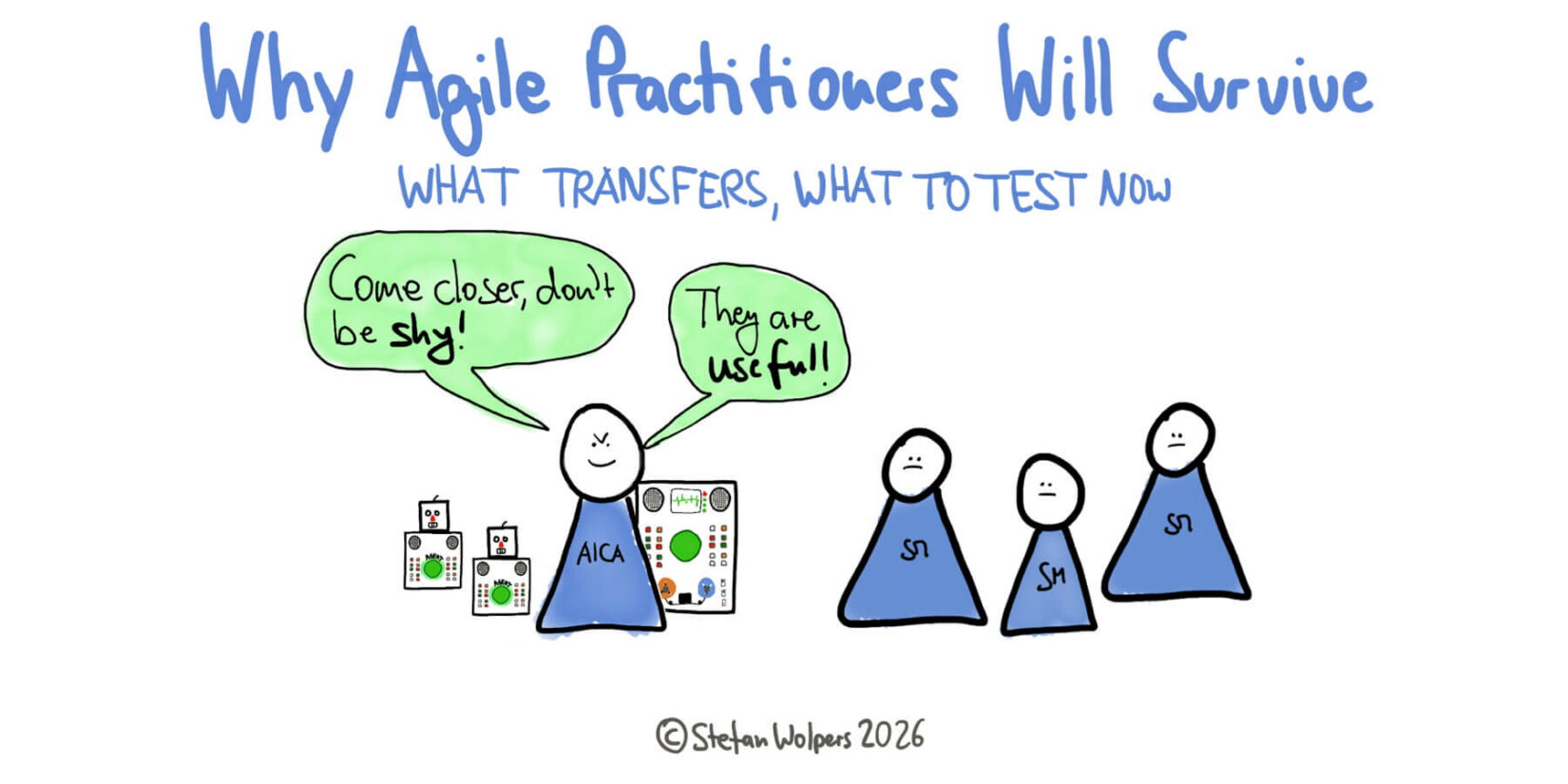
- What transfers: Organizational change expertise, empirical process control, and cross-functional translation. The hard parts of AI adoption are the parts you have been practicing for years.
- What does not: Framework expertise as a standalone value proposition, process facilitation without outcome ownership, and tool-agnosticism as a point of pride.
- What to do this week: Run one small experiment that integrates AI into your actual work. Before you prompt, categorize the task: Assist, Automate, or Avoid.
What would remain of your professional value if you removed every framework name and certification from your resume? Whatever that is: Invest there.
🎓 🇬🇧 🤖 OUT NOW — The AI 4 Agile Online Course v2 at $149
The AI4Agile Online Course v2 teaches you to use AI in your daily agile work. Every lesson uses MegaBrain.io, a fictional startup where you apply AI to Sprint Retrospectives, stakeholder reports, product discovery, and backlog analysis.
72 video lessons. 13+ hours. 9 hands-on exercises. 155+ downloadable resources. 11 modules covering prompt engineering, Claude Skills, Claude Cowork, data analysis, and a framework for deciding where AI helps and where it does not.
No coding required. You leave knowing which tools to use and where to draw the line. This course shows you how to do that precisely .
The latest Version 2 is now available and comes with an introductory price of $149 instead of $249—don’t miss this opportunity to save $100!
👉 Join 500+ Peers and Save $100—But Only Until March 9: AI4Agile Online Course v2 at $149.
🗞 Shall I notify you about articles like this one? Awesome! You can sign up here for the ‘Food for Agile Thought’ newsletter and join 35,000-plus subscribers.
The Diagnosis Was 2 Weeks Ago. This Week: The AI for Agile Practitioners Treatment
In Part 1, I argued that agile practitioners are better positioned for the AI era than the doom narrative suggests, not because “people skills still matter” (the weakest defense in the industry), but because organizations adopting AI are failing for the same structural reasons they failed at Agile transformations: they cannot change how work gets done.
This week, let us explore what you can do about it, not next year, but within the upcoming three months.
Your Anxiety Is a Signal, Not a Verdict
First, let me name what is happening to you psychologically, because pretending it is purely a skills question does not help.
If you have built your career around agile practice and you are now watching AI automate tasks you used to own and organizations abandoning “Agile” for their home-made flavor of a product operating model, you are experiencing what Virginia Satir described in her change model: the chaos stage that follows when a foreign element disrupts the status quo. [2] Your old identity (“I am valuable because I know Scrum”) is cracking, and the new one has not formed yet.
The problem is that most people try to escape the chaos by either denying the disruption (“AI is just hype”) or panic-buying credentials (“I need three more certifications”) — neither works. (And yes, an em dash is the right choice in this context.) What works is what you tell your teams every Sprint: inspect, adapt, run a small experiment, learn something, repeat.
You already know the methodology for navigating your own career uncertainty. You just forgot to apply it to yourself.
An Honest Assessment: What Transfers and What Does Not
Not everything in your toolkit survives this shift. Let me be direct about both sides:
What Transfers Directly
Organizational change expertise: The top barrier to AI adoption is organizational, not technical. Harvard Business Review published research in November 2025 confirming that most firms struggle to capture value from AI because of “people, processes, and politics,” not because the technology fails. [1] Your years of navigating resistant organizations, sensing unwritten rules, and helping teams through uncomfortable transitions are the hard part. Data science teams will have a hard time doing so.
Empirical process control: The difference between an organization that scales AI and one that stays in pilot purgatory is whether it can run honest experiments, inspect results without ego, and adapt based on evidence: what AI pilots are creating value, where should we double down? In my consulting practice, I have seen the same pattern repeatedly: the organizations that succeed with AI are those where someone insists on treating every application as a hypothesis, not a commitment; Agile’s core operating principle, applied to a new domain.
Cross-functional translation: Product Managers (and Product Owners) who have spent years translating between business stakeholders and development teams have exactly the skill that AI initiatives need most. Someone has to bridge the gap between “what the model can do” and “what the business needs.” Someone has to ask “what customer problem does this solve?” before the team spends three months fine-tuning a model nobody will use.
What Does Not Transfer
Framework expertise as a standalone value proposition: Knowing the Scrum Guide has become a nice-to-have. If your only differentiator is “I can explain the Sprint Retrospective format,” AI has already commoditized that knowledge. (It was heading that direction; just AI accelerated the inevitable.)
Process facilitation without outcome ownership: Running events without connecting them to measurable outcomes was always a weak position. AI makes it indefensible. If you cannot answer “what business result did your last [insert a team action of choice here] produce?” with something concrete, the conversation about AI replacing your role becomes harder to counter.
Tool-agnosticism as a point of pride: Some agile practitioners wear their unfamiliarity with tools as a badge. “I am about people, not technology.” In 2026, refusing to understand how AI tools work, what they can and cannot do, and how they change team dynamics, is the equivalent of a Product person who refuses to look at the product. You do not need to become a data scientist. You do need to be AI-literate enough to make informed decisions about where AI helps and where it creates risk. (Consider the A3 Decision Framework as a starting point.)
AI for Agile Practitioners: What to Do by Next Friday
Anxious people are paralyzed by grand career strategies. So forget the five-year plan. Here is what to do this week:
If You Are a Scrum Master
This week: Use an LLM to analyze your last three Sprint Retrospective results. Ask it to identify recurring patterns your manual facilitation missed. Bring the analysis to your next Retro as a conversation starter, not a replacement for the conversation.
What you are testing: Does AI-assisted pattern recognition surface blind spots in your facilitation? And does your team trust the insight when it comes from a machine?
If You Are an Agile Coach
This week: Identify one organization-level bottleneck that has survived three consecutive Retrospectives. Draft a one-page proposal for a two-week experiment to address it, using AI to research comparable patterns in other organizations. Include the cost of inaction in the proposal.
What you are testing: Are you coaching process compliance or organizational problem-solving? The answer determines your relevance over the next 6-12 months.
If You Are a Product Manager
This week: Pick one competitor’s product and ask an LLM to generate a structured analysis of their last three releases based on publicly available information, then compare its analysis to yours. Where does the AI add perspective? Where does it miss context that you have from domain expertise?
What you are testing: Can you use AI as an analytical sparring partner rather than just a drafting tool?
If You Are a Product Owner
This week: Take your three lowest-priority Product Backlog items and ask an LLM to generate customer interview questions that would validate or invalidate their underlying assumptions. Share the questions with one stakeholder.
What you are testing: Can AI accelerate your discovery process without replacing your judgment about what matters?
The point is not that these experiments will transform your career by Friday. The point is to break the paralysis. Run a small experiment. Learn something concrete. Decide what to try next based on evidence, not anxiety.
The Skill That Matters Most Right Now
Across all four experiments above, one skill separates the practitioners who will thrive from those who will struggle: The ability to integrate AI into existing expertise rather than treating it as a separate domain.
A fool with an LLM is still a fool. AI amplifies what you already are. If you are a competent Scrum Master who understands team dynamics, AI makes you faster at pattern recognition and more thorough in your preparation. If you are an incompetent Scrum Master who hides behind the framework, AI helps you produce polished-looking artifacts that still solve nothing. (DKaaS, or Dunning-Kruger-as-a-service, so to speak.)
The practitioners I see making the fastest progress start with a real problem from their daily work, use AI to approach it differently, and then evaluate whether the result was better, worse, or just different. Empiricism applied to professional development.
But integration requires a prior decision that most practitioners skip: before you open an LLM, you need to know whether AI should be involved at all. Once you know how to prompt effectively, the next question is when to prompt at all. That is what the A3 Framework: Assist, Automate, Avoid addresses. Categorize the task first:
- “Assist” means AI drafts, you decide.
- “Automate” means AI executes under explicit rules with regular audits.
- “Avoid” means the task stays entirely human because the cost of failure is a loss of trust.
Prompting skill without delegation judgment produces fast, confident mistakes. The A3 Framework adds the judgment. (The A3 Handoff Canvas is available as a free download.)
What Changed in the AI 4 Agile Course Version 2
I built the first version of the AI 4 Agile Online Course in late 2025 because I saw the gap I have been describing in these two articles: agile practitioners who needed to integrate AI into their work but found no training designed for how they actually think and operate. Over 500 people took it. The feedback was clear: the basic structure works. But the field moved fast, and several topics that were optional six months ago are now essential.
Version 2, launched on March 2, builds on Version 1 and adds the sessions that practitioners told me they needed. The new material covers:
- Claude’s Skills and how to use them in daily practice,
- Claude Cowork as an entry point for non-technical practitioners to work with autonomous AI agents and understand the paradigm shift they represent,
- The A3 Framework for AI delegation decisions,
- 10 hacks for the impatient who want to get more out of large language models right now, and
- How to position yourself as a thought leader using AI as a leverage point.
The course still includes everything that made Version 1 valuable, from the prompt engineering approach I use in my own consulting to the practical integration work: Sprint Retrospectives, Product Backlog refinement, stakeholder communication, and organizational diagnostics.
The AI 4 Agile Online Course Version 2 is available starting March 2 at $149 instead of $249. The introductory price is available until March 9. If you took Version 1, the upgrade is included.
I am not going to pretend this is a neutral recommendation. I built it because I needed it myself, and I expanded it because practitioners kept asking for the topics Version 1 did not cover. Whether you take the course or not, the experiments above are free and start now.
👉 Join 500+ Peers and Save $100—But Only Until March 9: AI4Agile Online Course v2 at $149.
Conclusion: The Question That Determines Your 2026
The organizations failing at AI need someone who can run honest experiments, navigate resistance, translate between technical and business teams, and redesign how work gets done without everything falling apart. You recognize that job description. The posting might say “AI Transformation Lead” or “Digital Change Manager.” The actual work is what you have been practicing, often imperfectly and sometimes unsuccessfully, for years.
The opportunity is real, but it is not automatic. It requires you to stop defining yourself by the framework you practice and start defining yourself by the organizational problems you solve. It requires learning enough about AI to make informed decisions. And it requires the same thing you ask of your teams every Sprint: inspect honestly and adapt based on what you find.
What would remain of your professional value if you removed every framework name and certification from your resume? Whatever that is: Invest there.
References:
[1] Harvard Business Review: Overcoming the Organizational Barriers to AI Adoption, November 2025.
[2] Virginia Satir, John Banmen, Jane Gerber, and Maria Gomori, The Satir Model: Family Therapy and Beyond (Palo Alto, CA: Science and Behavior Books, 1991). For an accessible summary of the change model stages, see Steven M. Smith: The Satir Change Model.
📖 AI for Agile Practitioners — Related Posts
Why Agile Practitioners Should Be Optimistic for 2026 (Part 1): You Have Already Survived This
The AI4Agile Practitioners Report 2026
Assist, Automate, Avoid: How Agile Practitioners Stay Irreplaceable with the A3 Framework
Agile Is Dead, Long Live Agility
The Reformation That Became the Church
The Immunity Response: How Organizations Neutralize Change

👆 Stefan Wolpers: The Scrum Anti-Patterns Guide (Amazon advertisement.)
📅 Scrum Training Classes, Workshops, and Events
Learn more about the Survival of Agile Practitioners with our AI and Scrum training classes, workshops, and events. You can secure your seat directly by following the corresponding link in the table below:
| Date | Class and Language | City | Price |
|---|---|---|---|
| 🖥 💯 🇬🇧 March 19-April 16,2026 | GUARANTEED: AI4Agile BootCamp #6 — March 19-April 16,2026 (English; Live Virtual Cohort) | Live Virtual Cohort | €499 incl. 19% VAT |
| 🖥 🇩🇪 April 22-23, 2026 | Professional Scrum Product Owner – AI Essentials Training (PSPO AIE; German; Live Virtual Class) | Live Virtual Class | €799 incl. 19% VAT |
| 🖥 🇩🇪 May 19-20, 2026 | Professional Scrum Product Owner Training (PSPO I; German; Live Virtual Class) | Live Virtual Class | €1.299 incl. 19% VAT |
See all upcoming classes here.

You can book your seat for the training directly by following the corresponding links to the ticket shop. If your organization’s procurement process requires a different purchasing approach, please contact Berlin Product People GmbH directly.
✋ Do Not Miss Out and Learn More about AI for Agile Practitioners — Join the 20,000-plus Strong ‘Hands-on Agile’ Slack Community
I invite you to join the “Hands-on Agile” Slack Community and enjoy the benefits of a fast-growing, vibrant community of agile practitioners from around the world.

If you would like to join all you have to do now is provide your credentials via this Google form, and I will sign you up. By the way, it’s free.