


AI Transformation Anti-Patterns (And How to Diagnose Them)
TL;DR: AI Transformation Anti-Patterns
AI initiatives fail for the same reasons Agile transformations did: The majority of failures result from people, culture, and processes, not technology. This article gives you a diagnostic checklist of 10 AI transformation anti-patterns to spot where your organization’s initiatives are coming off track.
🎓 🇬🇧 🤖 The AI 4 Agile Online Course v2 at $149 — March 2, 2026
I developed the self-paced AI 4 Agile Online Course for agile practitioners, including Product Owners, Product Managers, Scrum Masters, Agile Coaches, and delivery professionals who want to integrate artificial intelligence into their workflows with clarity, ethics, and purpose.
You don’t need to become an AI expert. However, you do need to understand how LLMs like ChatGPT, Claude, or Gemini can support real agile work and where their limitations lie. As Jim Highsmith said, AI isn’t just a tool, but a new context for agility. This course shows you how to do that precisely .
The latest Version 2 will be released on March 2 and comes with an introductory price of $149 instead of $249—don’t miss this opportunity to save $100!
👉 Don’t like to wait until March 2? Go shopping Version 1 now at $199. (The upgrade to version 2 is included.)
Join 400-plus Peers — What Is Included:
- 10+ hours of self-paced video modules: Hacks, Skills, Agents
- A cohort-hardened, proven course design
- Learn to 10x your effectiveness with AI; your stakeholders will be grateful
- Delve into classic agile use cases of AI
- Help your team create more customer value
- All texts, slides, prompts, graphics; you name it
- Access custom GPTs, including the “Scrum Anti-Patterns Guide GTP”
- Enjoy community access for peer learning
- Guaranteed: Lifetime access to all course updates and materials; there is a lot more to come
- The AI4Agile Foundation Certificate.

👉 Please note: The course will only be available for sign-up at $149 until March 9, 2026! 👈
🎓 Join the Waitlist of the AI 4 Agile Online Course v2 Now: Master AI Integration for Agile Practitioners—No AI Expertise Required!
🗞 Shall I notify you about articles like this one? Awesome! You can sign up here for the ‘Food for Agile Thought’ newsletter and join 35,000-plus subscribers.
Why Your AI Initiative Is Failing
Your organization announced an AI initiative, the leadership bought licenses, and someone launched a pilot. The quarterly review called it a success. Six months later, nobody uses it.
This pattern isn’t new; remember the Agile transformation that became process theater, or the digital transformation that produced dashboards nobody reads? What about the DevOps push that added tools, processes, and layers without changing behavior? AI initiatives fail for the same reasons, and you can spot the failure early enough to do something about it.
Over the past several weeks, I reviewed four sources on why AI transformations fail: Harvard Business Review’s 5Rs framework, Simon Powers’ work on organizational fields, Barry O’Reilly’s due diligence framework for AI ventures, and Paul Roetzer’s research on AI adoption as change management; see below. From these, I (with Claude’s support) have built a diagnostic taxonomy of 166 distinct AI transformation anti-patterns across 16 categories.
The complete AI Transformation Anti-Patterns taxonomy is part of my AI 4 Agile Online Course, but this post gives you a diagnostic lens you can use now.
The AI Transformation Anti-Pattern You Already Recognize
Many people assume AI initiatives fail because of technology: the wrong model, insufficient training data, hallucinations, latency, and cost. That’s usually not the root cause.
When you group failure patterns by root cause, you get a different distribution:
- Organizational failures (governance, roles, process, culture): ~65%
- Technical failures (data, robustness, security, transparency): ~22%
- Contextual failures (field dynamics, product viability): ~14%.
(Percentage values refer to the 166 distinct AI transformation anti-patterns mentioned above.)
The technology works. The organization does not.
If you’ve lived through Agile transformations, you’ve seen this split before. Two-thirds of the problem lies in people and processes, while the technology is typically the easier part.
Cannot see the form? Please click here.
The AI Transformation Anti-Patterns Diagnostic Framework: 16 Categories
The taxonomy groups AI transformation anti-patterns into 16 categories. Each category is a diagnostic lens.
Organizational categories:
- Governance & Accountability
- Roles & Skills
- Process & Rituals
- Resources & Infrastructure
- Metrics & Results
- Culture & Change Management
- Responsible AI
- Scaling & Sustainability
Technical categories:
- Data & Bias
- Robustness & Reliability
- Security & Attacks
- Transparency & Explainability
- Regulatory & Compliance
- Ethical & Societal
Contextual categories:
- Field Awareness & Relational Context
- Product & Technical Viability
You don’t need all 166 patterns to run a proper diagnostic. You need to spot the patterns that kill initiatives versus the ones that only slow them down. I rate each pattern by severity: “Kills the initiative,” “Slows progress,” or “Creates friction.”
31 percent of the patterns are fatal; one in three. Catch them early or pay later.
Ten AI Transformation Anti-Patterns Worth Knowing
If you work in Agile, most of these will look familiar. That recognition should be uncomfortable.
The License-and-Hope Anti-Pattern
The organization buys AI tools before it understands the organizational changes required to use them; perhaps the budget was available. It hopes people adopt. However, incentives don’t change, there’s no change management effort, and, consequently, no value created.
If the organization measures success with a dashboard showing login rates, it becomes an easy victory. But what if nobody uses it, beyond the login?
Jira doesn’t make you agile. Licensing ChatGPT doesn’t make you AI-native.
Severity: Kills the initiative.
The Pilot Graveyard
The organization funds many greenfield pilots but has no way to graduate successful ones to production. Pilots succeed in isolation, then die when the proof-of-concept budget runs out.
Alternatively, a team tests for 12–24 months without scaling. The organization is perpetually “still training the model on proprietary data” or “refining the algorithm.” The pilot never graduates. If someone tells you the same “almost ready” story for the third quarter in a row, you’re looking at a zombie pilot.
Severity: Kills the initiative.
Missing Translator
Nobody bridges the gap between data scientists and business stakeholders. Technical teams build what they think is useful. Business teams can’t articulate their needs. Both sides blame each other.
If you’re a Scrum Master, a Product Owner, or a Product Manager, you may already be doing this translation. The skill transfers directly, which also makes change veterans like agile practitioners well-suited to accompany new “AI initiatives.”
Severity: Slows progress.
Ignored Fear
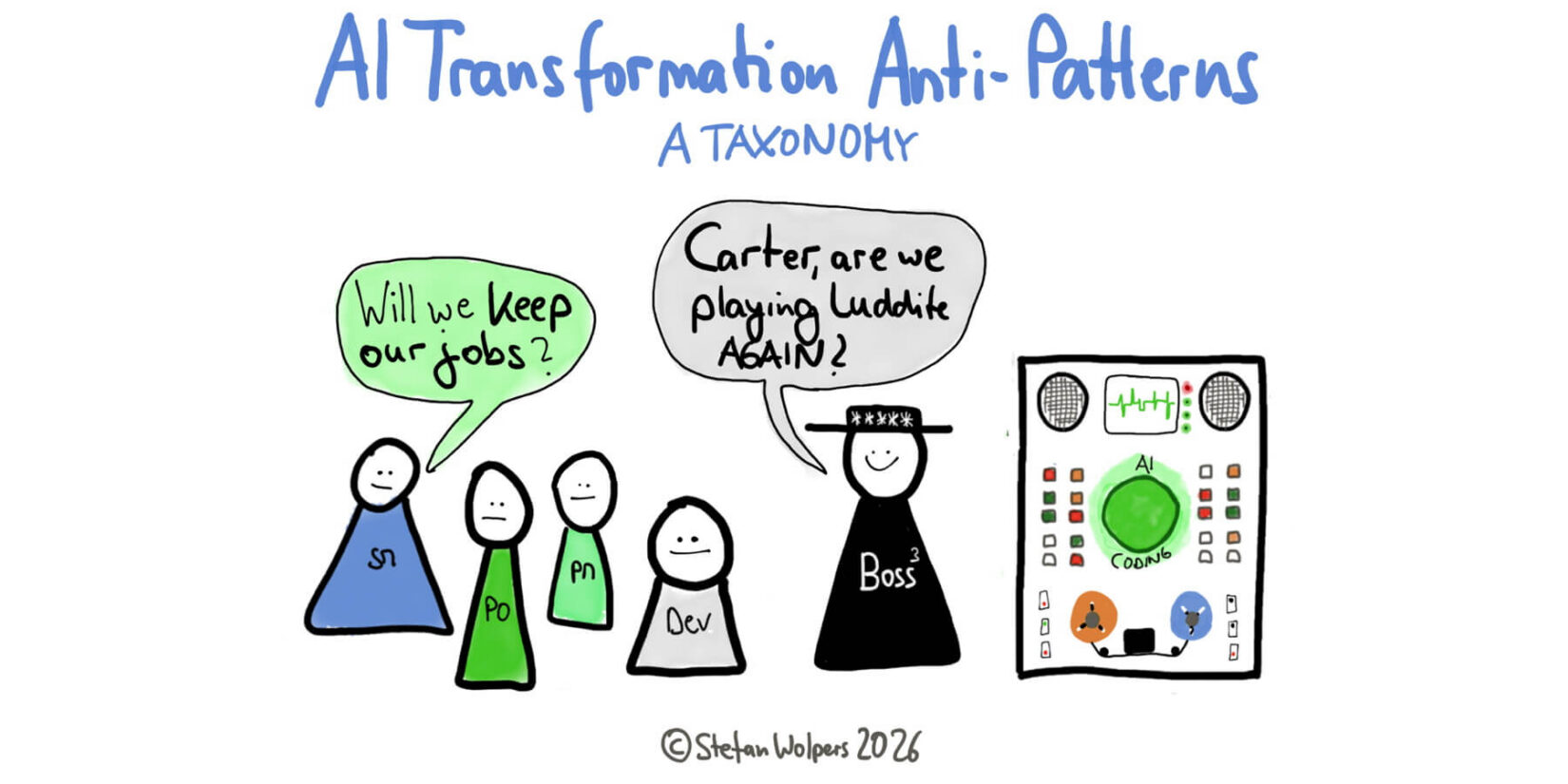
Employees fear job displacement, and leadership doesn’t name it. Consequently, resistance goes underground, and people sabotage AI adoption to protect their roles. Unsurprisingly, supporting personal agendas can be more important than following the latest company initiatives.
Transparency, addressing the elephant in the room, is essential for any change initiative. You need to help your people also understand why the change is beneficial to them.
Severity: Kills the initiative.
No Reflection On AI Effectiveness
Teams use AI but never discuss it in Refinement, Sprint Review, or Retrospectives. There’s no standing question like: “Where did AI increase flow? Where did it increase the risk? Where did we feel judged or replaced?”
Add one question to your next Retrospective: “How is AI affecting our work?” Then listen.
Severity: Creates friction.
Shadow AI
Teams or individuals deploy or use AI tools outside official governance because the organization is to slow to adapt or the provided AI tools are not suited for what they are intended to do. There’s no visibility into what models are running, what data they access, or what decisions they influence.
Marketing uploads customer data to a free AI tool. Legal finds out after a complaint. By then, the damage is done.
Severity: Kills the initiative.
Field Blindness
Leaders and change agents can’t sense the emotional tone, power dynamics, shared assumptions, and unwritten rules that shape behavior. They design interventions for the visible system while the invisible system blocks change.
Simon Powers inspires this AI transformation anti-pattern. The “field” is the relational context that shapes what is possible. Ignore it, and your transformation plan fails. The post-mortem blames “culture” without naming anything specific. I’ve seen this happen in organizations that did everything else right. After all, culture is what happens when you are not looking.
Severity: Kills the initiative.
Traction Is All Talk
White papers, “research partnerships,” and pilot claims exist, but there are no paying repeat users. The organization confuses activity with traction; a tragic pattern when it applies to your AI tool vendors.
This anti-pattern matters in vendor selection. Ask for real references, not unpaid “strategic partnerships.” If they can’t name three customers who renewed, walk away.
Severity: Kills the initiative.
Secret Sauce Is a Prompt
The vendor’s “proprietary algorithm” is a prompt template on a general LLM. There’s no unique model, proprietary training, or moat.
Due diligence question: “What would stop me from replicating this with a $20/month Claude subscription?” If the answer is vague, you have your answer.
Severity: Kills the initiative.
Deployment Speed Exceeds Governance Capacity
AI spreads faster than the organization can assess risks. Teams deploy before compliance can review. The benefits are attractive, so risks are accepted by default.
The parallel to Agile is shipping before things are “Done,” probably including the promise to “fix it later,” which rarely happens: same gap, different tech.
Severity: Slows progress.
The Cold Numbers
Out of the 166 patterns in the complete taxonomy:
- 52 patterns (31%) are fatal: “Kills the initiative”
- 85 patterns (51%) degrade outcomes: “Slows progress”
- 29 patterns (18%) create friction but are survivable.
One in three patterns is fatal. Count how many you recognized here.
Conclusion: What to Do Monday Morning
Score your current AI initiative against the 10 patterns above:
- License-and-Hope: Did we buy tools before planning how to initiate behavior change? Are processes and incentives unchanged?
- Pilot Graveyard: Is anything “almost ready” for more than two quarters? Do pilots succeed but never reach production?
- Missing Translator: Who bridges data science and business?
- Ignored Fear: Has leadership addressed job displacement concerns?
- No Reflection: Does AI come up in Retrospectives?
- Shadow AI: What tools are people using that IT doesn’t know about?
- Field Blindness: What’s the unwritten rule blocking adoption?
- Traction Is All Talk: Can your vendors name three customers who renewed?
- Secret Sauce Is a Prompt: Could you replicate it with a Claude subscription?
- Governance Gap: Are teams deploying faster than compliance reviews?
Start the diagnostic habit now. A simple anonymous survey will start the conversation; just copy & paste the ten patterns into a form application:
- Three or more checks? Escalate.
- Patterns across multiple categories? The initiative is in hospice, and someone needs to say that out loud.
The complete taxonomy, with 166 patterns and recovery actions, is part of my AI 4 Agile Online Course, version 2 of which will be available on March 2 for $149.
So, which patterns did you recognize?
Sources for AI Transformation Anti-Patterns
Most AI Initiatives Fail. This 5-Part Framework Can Help.
DC84: Chapter 3: Fields and Awareness
When AI Projects Are Zombies, Ghosts, or Ghouls and How to Spot Them
📖 AI Transformation Anti-Patterns — Related Posts
Ralph Wiggum Ships Code While You Sleep. Agile Asks: Should It?
Assist, Automate, Avoid: How Agile Practitioners Stay Irreplaceable with the A3 Framework
Agile Is Dead, Long Live Agility
The Reformation That Became the Church
The Immunity Response: How Organizations Neutralize Change
The Immunity Response: How Organizations Neutralize Change

👆 Stefan Wolpers: The Scrum Anti-Patterns Guide (Amazon advertisement.)
📅 Scrum Training Classes, Workshops, and Events
Learn more about the Agile AI Manifesto with our AI and Scrum training classes, workshops, and events. You can secure your seat directly by following the corresponding link in the table below:
| Date | Class and Language | City | Price |
|---|---|---|---|
| 🖥 💯 🇬🇧 February 3, 2026 | GUARANTEED: Hands-on Agile #71: A3 Framework — Assist, Automate, Avoid — Let’s Build a Playbook! (English) | Live Virtual Workshop | FREE |
| 🖥 💯 🇩🇪 February 10-11, 2026 | GUARANTEED: Professional Scrum Product Owner Training (PSPO I; German; Live Virtual Class) | Live Virtual Class | €1.299 incl. 19% VAT |
| 🖥 💯 🇬🇧 February 19, 2026 | GUARANTEED: Hands-on Agile #72: Become Your Organization’s AI Champion: A Crowdsourced Playbook (English) | Live Virtual Workshop | FREE |
| 🖥 🇬🇧 March 10-11, 2026 | Professional Scrum Master—Advanced Training (PSM II; English; Live Virtual Class) | Live Virtual Class | €1299 incl. 19% VAT |
| 🖥 💯 🇬🇧 March 19-April 16,2026 | GUARANTEED: AI4Agile BootCamp #6 — March 19-April 16,2026 (English; Live Virtual Cohort) | Live Virtual Cohort | €499 incl. 19% VAT |
| 🖥 🇩🇪 March 24-25, 2026 | Professional Scrum Product Owner Training (PSPO I; German; Live Virtual Class) | Live Virtual Class | €1.299 incl. 19% VAT |
See all upcoming classes here.

You can book your seat for the training directly by following the corresponding links to the ticket shop. If your organization’s procurement process requires a different purchasing approach, please contact Berlin Product People GmbH directly.
✋ Do Not Miss Out and Learn More about AI Transformation Anti-Patterns — Join the 20,000-plus Strong ‘Hands-on Agile’ Slack Community
I invite you to join the “Hands-on Agile” Slack Community and enjoy the benefits of a fast-growing, vibrant community of agile practitioners from around the world.

If you would like to join all you have to do now is provide your credentials via this Google form, and I will sign you up. By the way, it’s free.