


Jira to AI Agents: From Project Management Tool to Project Knowledge Architecture
TL;DR: Jira to AI Agents
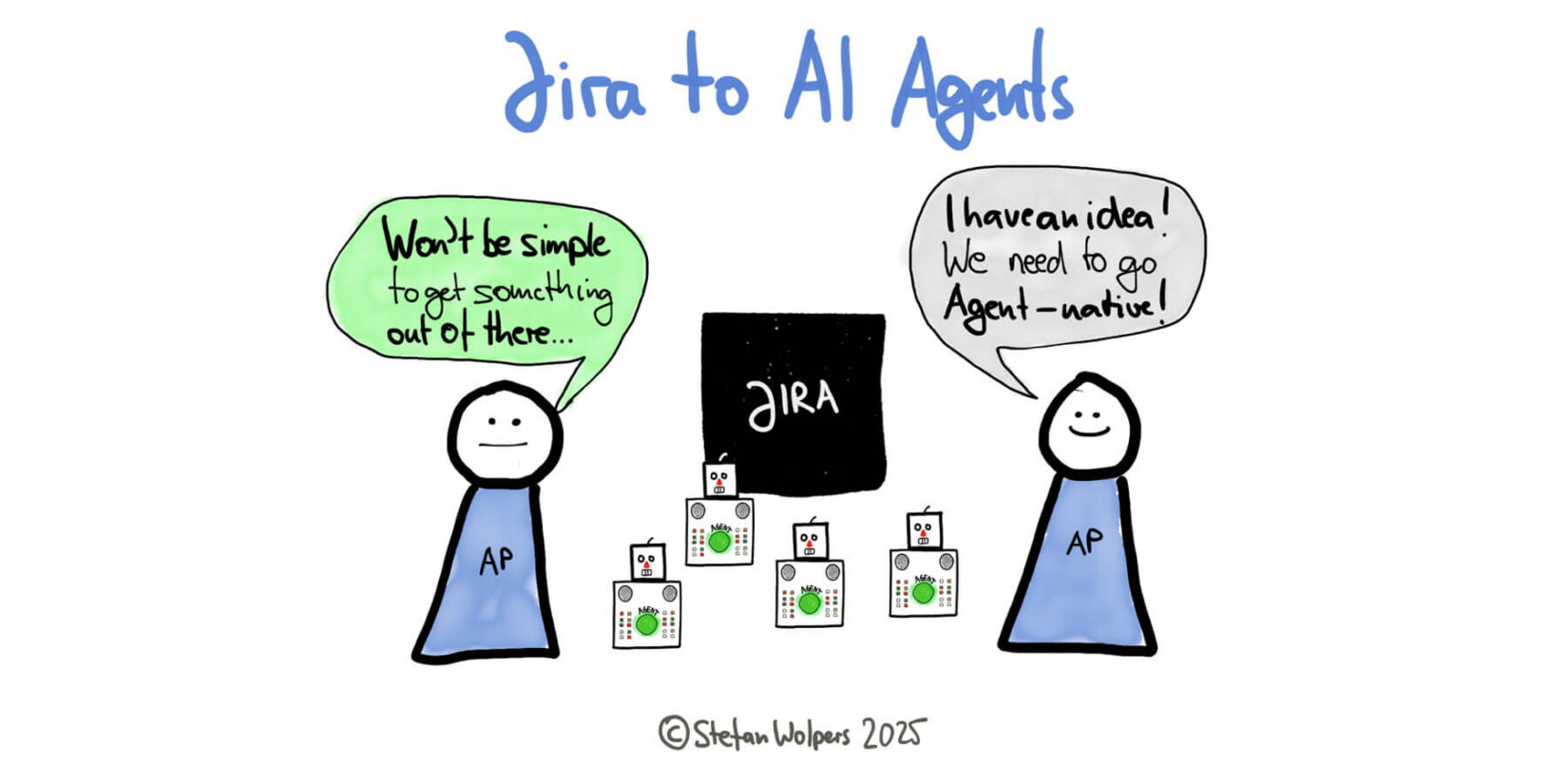
Jira was named after Godzilla and built to track bugs. It became the default agile tool because it satisfied a deeply human desire: controlling work by putting it in boxes with statuses, assignees, and due dates. That system works for humans scanning dashboards. It does not work for autonomous agents that need to reason about patterns across iterations, detect recurring problems, and forecast what is likely to break next. This article argues that the tool on which 62% of agile teams rely is about to be demoted from knowledge authority to execution interface. We need to move from Jira to AI Agents.
🎓 🇬🇧 🤖 The Claude Cowork BootCamp — $149
Cowork turns Claude into an autonomous AI agent who works on your tasks independently; no coding required.
In this hands-on founding cohort, you will build your own AI agents from scratch, using your real work challenges:
- Three Wednesday sessions, three hours each, April 15 to 29, 2026, at 3 pm CEST / 9 am ET. Limited spots.
- Prerequisite: Claude Pro subscription and the Claude Desktop app on macOS or Windows.
👉 Start Building Agents: Claude Cowork BootCamp: Build Your Own AI Agent, No Coding Required.
🗞 Shall I notify you about articles like this one? Awesome! You can sign up here for the ‘Food for Agile Thought’ newsletter and join 35,000-plus subscribers.
🎓 Join Stefan in one of his upcoming Professional Scrum training classes!
Jira’s Origin
In the 17th Annual State of Agile report (2023), 62% of respondents named Jira as their team-level agile tool. (The 18th edition, published in October 2025, shifted its focus entirely to AI and no longer included tool-usage questions.) The 2024 Stack Overflow Developer Survey found that 57.5% of professional developers use Jira as a collaborative work management tool. Atlassian says more than 300,000 companies have adopted it.
Jira was not built for agile work. Atlassian launched it in the early 2000s as an issue tracker. The name is a truncation of “Gojira,” the Japanese word for Godzilla, which is what Atlassian’s developers called Bugzilla, the bug tracker they used internally before building their own. Agile capabilities were added over time: Atlassian acquired GreenHopper in 2009, adding release planning, burndown charts, and the agile board features that became standard in Jira. Scrum boards became a built-in Jira feature in 2012. But the underlying object model remained issue-centric. The agile features sit on top of a ticket database.
The ticket-system DNA never left. Mandatory fields, status transitions, workflow schemes: everything assumes work is a ticket to be tracked, not a problem to be solved. Many practitioners know this. Some hate Jira openly. Others tolerate it because procurement approved it a decade ago, and switching costs feel prohibitive.
The next challenge is not about friction, but about a change in who consumes project data, and what they need from it.
Cannot see the form? Please click here.
How Jira Became the Default
Between 2002 and 2010, Jira spread through organizations the way most enterprise software does: IT installed it for bug tracking, and when teams decided to “go Agile,” it was already there. After the GreenHopper acquisition in 2009, Jira had agile boards, but they were a view layer on top of a ticket database. The mismatch was manageable because teams were small and the Scrum events compensated for what the tool could not do.
Between 2010 and 2020, corporate agile adoption turned Jira into the default, as procurement had already approved it. The Atlassian Marketplace launched in 2012, and the plugin ecosystem deepened the lock-in. Organizations customized heavily. In my consulting practice across European enterprises, I have seen Jira instances with 300+ custom fields, and that is not unusual. Jira became the system of record, but the record it kept was optimized for human dashboard consumption: status updates, burndown charts, velocity graphs. Data went in as tickets.
It came out as reports for humans to read on screens. (I still recall the “Definition of Ready” plugin and the resulting report that a VP of a client insisted on receiving every single Sprint. He was more interested in that output than the customer value delivered.)
The Problem with Jira in the Age of AI Agents
Since 2020, though, AI has changed the question. Practitioners started wanting to analyze Sprint patterns across time, predict delivery risk, assess Product Backlog health, and map dependencies automatically. They tried to extract context from Jira. What they got was an API that returns ticket metadata: status, assignee, priority, transitions. The temporal dimension, how things changed across Sprints, is buried in issue histories that require multiple API calls and interpretation to reconstruct. Cross-artifact relationships are implicit, hidden in issue links and comment threads. Jira stores workflow state and fragmented context. It does not store a coherent, versioned knowledge model optimized for reasoning across time.
Atlassian’s Response Is Serious
Atlassian is not standing still, and dismissing their AI efforts would be dishonest.
They built Atlassian Intelligence across Jira, Confluence, and Jira Service Management. They built Rovo, an AI layer that provides semantic search, chat, and agent capabilities. In February 2026, they announced AI agents embedded directly in Jira (open beta), allowing teams to assign work to Rovo agents and MCP-enabled third-party agents. They adopted the Model Context Protocol to connect Rovo to external AI clients, including Claude, Cursor, and the Gemini CLI.
Underneath all of this sits the Teamwork Graph, which Atlassian describes as its platform’s data intelligence layer. It unifies data across Atlassian products and over 100 connected third-party apps. At the time of writing, Atlassian reports that the Teamwork Graph tracks over 100 billion objects and relationships. Teamwork Graph is not a bolt-on. It is an infrastructure designed to give AI features a richer data model than raw Jira tickets.
The Atlassian argument is clear: build intelligence on top of where the data already lives, rather than asking organizations to re-architect from scratch. That is a reasonable position. For organizations already deep in the Atlassian ecosystem, Rovo and the Teamwork Graph are the path of least resistance.
Also, here is where the argument breaks down.
The Teamwork Graph connects the items that have been captured. It maps relationships between existing objects: tickets, pages, messages, users, and projects. It can even surface some context from connected third-party systems through its 100+ connectors. What it cannot fully compensate for is context that was never explicitly captured or consistently structured in a form that supports agent reasoning across time:
- Why did the team change the scope in Sprint 23?
- What trade-off did the Product Owner make when she deprioritized the performance work?
- What pattern connects rising bug counts in one team to declining morale in another?
This knowledge lives in people’s heads, in meeting notes that never entered the system, in Slack threads that scrolled past, in Retrospective outcomes a Scrum Master captured on a whiteboard and photographed but never structured.
Rovo can summarize a Jira ticket thread. It can translate natural language into JQL. It can automate workflow transitions. All of this is useful. But it operates within the boundaries of what Jira and connected tools have captured, and the capture model was designed for humans tracking ticket status, not for agents reasoning about project evolution over time.
Jira to AI Agents: What Agents Need That Ticket Systems Do Not Provide
An agent analyzing project performance needs to reason about change over time. Not the current state of a board, but the trajectory: what was planned, what happened, what was learned, and how that learning influenced the next cycle.
Consider a concrete scenario: a Scrum Master wants to understand why team performance declined between Sprints 22 and 24. The agent needs the Product Backlog state at the start of Sprint 22, the commitment the team made, what changed mid-Sprint, what the Retrospective surfaced, and how those findings influenced Sprint 23 planning. It needs to compare three points in time and detect patterns across the transitions.
In Jira, this information is fragmented across issue histories, comment timestamps, and Sprint reports. Assembling a coherent picture requires significant effort. Most practitioners lack the technical skills to extract and reassemble this from the API, and most agents struggle to do so reliably without structured input.
Now consider a different information architecture. The project knowledge lives in Markdown files organized by Sprints:
megabrain-io/
  sprint-22/
    sprint-goal.md
    selected-pbi.md
    daily-notes/
      day-01.md
      day-05.md
    retrospective-outcomes.md
    scope-changes.md
  sprint-23/
    sprint-goal.md
    selected-pbi.md
    ...
  team/
    working-agreements.md
    definition-of-done.md
    skills/
      retrospective-analyzer.md
      backlog-health-check.md
Each file is plain text. Each Sprint folder is a snapshot. The team/skills/ folder contains the agent configurations the team uses. When someone improves a configuration, the change is visible in the version history: what changed, who changed it, and when.
An agent reads the Sprint 22 folder, then the Sprint 24 folder, and compares. The temporal dimension is structural, not implicit. The relationships between artifacts are explicit in the file organization.
I ran a small comparison using three Sprint Retrospective summaries from my course’s MegaBrain.io scenario, using the same underlying data in two formats. The first format was a single continuous comment thread, the way Retrospective outcomes typically end up in a Jira ticket: three paragraphs of notes from three Sprints, with actions listed inline. The second format was three separate Markdown files, one per Sprint, each with explicit sections for Sprint Goal, metrics, unresolved issues carried from previous Sprints, and action items with ownership and status.
I gave both to an AI agent with the same prompt: “What patterns do you see across these three Retrospectives? What got identified but never resolved?”
The Markdown version surfaced the carry-over problem immediately: scope changes were raised in Sprint 22, carried as an open action to Sprint 23, and still unresolved in Sprint 24. The same was true for the burnout risk. The file structure made the recurrence visible because each file’s “Unresolved Issues” section explicitly referenced previous Sprints. (Yub, my beloved “Retrospective action item accounting.”) The flat comment thread contained the same information, but embedded in paragraphs where the temporal signal was weaker. The agent’s analysis from the thread was less specific about the duration and persistence of the unresolved items.
Okay, this difference is not inherent in the file format. A Jira comment could be structured with the same sections and carry-over tracking. The point is that the folder-per-Sprint convention with explicit status tracking encourages temporal structure that a flat comment thread does not enforce. The convention does part of the agent’s work before the agent starts.
I should be honest about what this comparison hides. The folder structure I described above is sometimes called a “vault,” borrowing the term from Obsidian and similar tools that treat a folder of Markdown files as a self-contained knowledge base. A real vault maintained by a team of seven people across twelve Sprints will develop its own problems: naming drift, inconsistent structure, files that someone should have committed but did not, and merge conflicts when two people edit the same document. The maintenance cost is real. (Of course, maintaining Jira is also not free.)
Both systems get messy. The question is which mess gives an agent more to work with. A messy Markdown vault with inconsistent naming but explicit Sprint snapshots still gives an agent temporal context that a Jira board, however well maintained, makes expensive to extract, because the board was not designed to preserve its own history in a machine-readable form.
My claim is not “Markdown is better than Jira.” It is that agentic project work needs a different substrate than legacy ticket systems were designed to provide. The real requirement is portable, versioned, agent-readable knowledge with explicit temporal snapshots. Markdown plus Git is one implementation. It is not the only one. Confluence with disciplined export snapshots could serve parts of this need. A graph database designed for temporal queries could serve it differently. The principle matters more than the tooling.
Jira to AI Agents Starts Small And Scaling Is Hard
A single practitioner can start this today. One folder on a laptop. No organizational permission required. The value appears the first time you ask an agent to compare two Sprint Retrospective outcomes, and it surfaces a pattern that your Jira reports never showed.
The hard part starts when you try to share it. A team vault requires conventions: who commits what, when, and in what format. It requires someone to maintain the structure, just as someone maintains the Jira board configuration today. The difference is that a text-file convention is cheaper to change than a Jira workflow scheme, and its version history makes its evolution visible.
At the organizational level, the questions get harder:
- Which agent configurations are approved?
- What version of the analysis template is the standard?
- How do you compare outcomes across teams?
There is no widely accepted operating model for governing agent configurations, skill sets, prompt libraries, or portable project knowledge at scale. Some organizations are building governance and approval controls around AI systems, and Atlassian itself is moving in this direction with role-based permissions for agents. But there is no established playbook.
(Organizations have seen this pattern before: when the official tooling is too slow or too rigid, teams build workarounds. The solution is not to ban the workarounds. It is to make the official path easier than the alternative.)
The Shift in Role
My point is not about ripping out Jira. That would be as disruptive as it is unnecessary. Jira is good at what it was designed for: tracking the status of work items across workflows. (Jira is pretty good at this if you refrain from too much customization and the establishment of an elaborate roles and permission system.)
What changes is Jira’s role in the information architecture. My argument is that you demote it from a knowledge authority to an execution interface. The authoritative project knowledge, the kind that agents need to reason about change over time, will increasingly live in a structured, versioned, portable format. Jira can feed into that repository. It can read from it. But it is no longer the system of record for project knowledge, because it was never designed to be one.
This applies beyond Jira. Any tool whose primary value is displaying data in a dashboard for humans faces the same pressure. A growing share of project-data consumption will shift from humans scanning boards to agents reading structured context. That shift is not complete, and it may take years. But where it happens, the tools that can serve as context providers become more valuable, and the tools that cannot become optional.
Try This Before You Decide to Go from Jira to AI Agents
Take the outcomes from your last three Sprint Retrospectives. If they are on sticky notes, type them up. (Of course, your LLM of choice can do that for you, too.) If they are in Confluence, copy the text. Put each one in a separate Markdown file: retro-sprint-22.md, retro-sprint-23.md, retro-sprint-24.md.
Give all three files to an AI agent (Claude, ChatGPT, whichever you use) and ask: “What patterns do you see across these three Retrospectives? What got identified but never resolved? What is getting worse?”
Compare the answer to whatever your Jira dashboards or Confluence pages told you about the same period.
That comparison will tell you more about the value of structured, agent-readable project knowledge than this article can. It takes fifteen minutes. The only cost is the honesty required to look at the result.
Conclusion
Ticket systems are not going away. But their role is changing. The organizations that separate project knowledge from project tracking will give their agents better context, and better context compounds.
Start with one folder, three Retrospective files, and a fifteen-minute experiment. If the agent finds something your dashboard missed, you have your answer. The rest is convention and discipline.
Jira to AI Agents — Related Articles
Three Thinking AI Skills to Sharpen Judgment
Why Agile Practitioners Should Be Optimistic for 2026 (Part 1): You Have Already Survived This
Why Agile Practitioners Should Be Optimistic for 2026 (Part 2): AI for Agile Practitioners
Assist, Automate, Avoid: How Agile Practitioners Stay Irreplaceable with the A3 Framework

👆 Stefan Wolpers: The Scrum Anti-Patterns Guide (Amazon advertisement.)
📅 Training Classes, Workshops, and Events
Learn more about the Survival of Agile Practitioners with our AI and Scrum training classes, workshops, and events. You can secure your seat directly by following the corresponding link in the table below:
| Date | Class and Language | City | Price |
|---|---|---|---|
| 🖥 💯 🇬🇧 April 15-29,2026 | GUARANTEED: Claude Cowork BootCamp — April 15-29,2026 (English; Live Virtual Cohort) | Live Virtual Cohort | $149 incl. 19% VAT (If applicable.) |
| 🖥 🇩🇪 April 22-23, 2026 | Professional Scrum Product Owner – AI Essentials Training (PSPO AIE; German; Live Virtual Class) | Live Virtual Class | €799 incl. 19% VAT (If applicable.) |
| 🖥 🇩🇪 May 19-20, 2026 | Professional Scrum Product Owner Training (PSPO I; German; Live Virtual Class) | Live Virtual Class | €1.299 incl. 19% VAT (If applicable.) |
| 🖥 💯 🇬🇧 May 28 to June 25,2026 | GUARANTEED: AI4Agile BootCamp #7 — May 28 to June 25,2026 (English; Live Virtual Cohort) | Live Virtual Cohort | €499 incl. 19% VAT (If applicable.) |
See all upcoming classes here.

You can book your seat for the training directly by following the corresponding links to the ticket shop. If your organization’s procurement process requires a different purchasing approach, please contact Berlin Product People GmbH directly.
✋ Do Not Miss Out and Learn More about Moving from Jira to AI Agents — Join the 20,000-plus Strong ‘Hands-on Agile’ Slack Community
I invite you to join the “Hands-on Agile” Slack Community and enjoy the benefits of a fast-growing, vibrant community of agile practitioners from around the world.

If you would like to join all you have to do now is provide your credentials via this Google form, and I will sign you up. By the way, it’s free.