


The Scrum-to-POM Transition Is a Role Repositioning Event
TL; DR: Scrum-to-POM Is Not About Frameworks
Two weeks ago, I asked my audience whether they wanted a short course on moving from Scrum to a Product Operating Model, and 22 answered. That was not the Scrum-to-POM dataset I hoped for, but it was valuable for the conversations. Interestingly, one pattern ran through more than a quarter of the responses: The people writing back were not asking about transformation practices or operating models. They were asking what was about to happen to their jobs.
Let me paraphrase some of their replies: One Agile Coach wrote that their role had already been made redundant, and the internal training their employer offered was not enough. Another asked a blunt question: “What will happen to my role?” A third described leadership, saying they wanted this shift, while their behavior remained inconsistent. A fourth reported confusion about what a product coach actually is. A fifth dismissed the whole discourse as high-level fluff, transformational buzzwords, zero accountability, and vague systems thinking with no teeth.
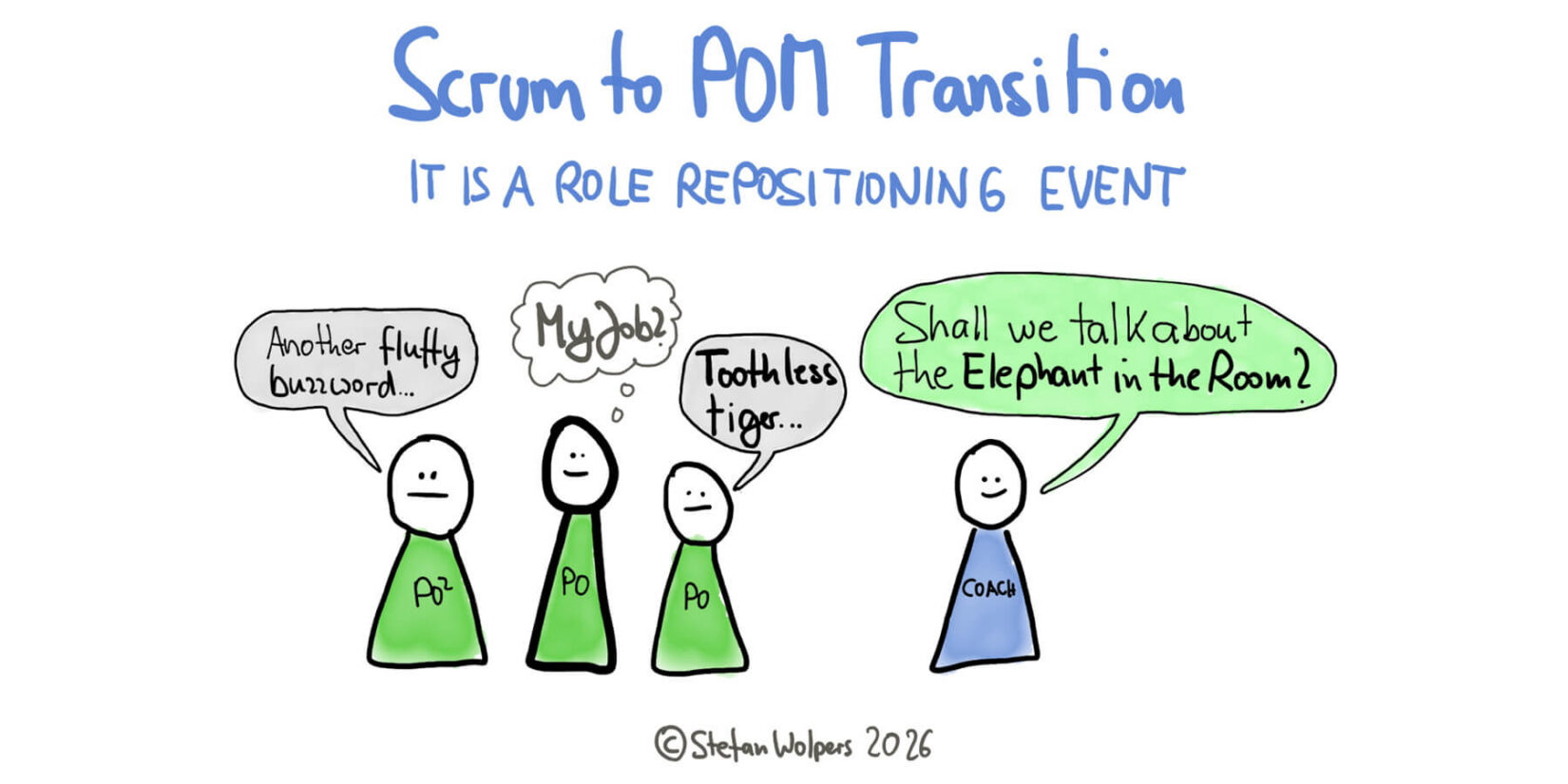
My takeaway: While the organizational design debate appears to be the surface, the ongoing role repositioning is what the people on the ground are living through.
🎓 🇬🇧 The Claude Cowork Online Course — Available June 1-8 for $129
You have been prompting AI for months. The results are inconsistent, every conversation starts from zero, and the model forgets who you are. That is the ceiling of prompting.
The Claude Cowork Online Course teaches you to break through it: build Skills that encode your expertise, connect them to your tools, and assemble Agents who handle recurring work the way you would handle it yourself. No coding required.
What You Will Get:
✅ 8+ hours of self-paced video modules: Skills, Agents, delegation frameworks — ✅ Tested with a live BootCamp cohort (April 2026) — ✅ The A3 Framework: decide what to delegate and what to keep — ✅ Starter kit with folder structure, CLAUDE.md, and Skill templates — ✅ All texts, slides, prompts, graphics; you name it — ✅ Designed for the $20/month Pro plan — ✅ Lifetime access to the version you purchase — ✅ Claude Cowork Foundational Certificate.

👉 Please note: The course will be available for $129 from June 1 to 8, 2026! (After that, $199.) 👈
🎓 Join the Waitlist of the Course Now: Claude Cowork: Stop Prompting. Start Delegating. No Coding Required!
🗞 Shall I notify you about articles like this one? Awesome! You can sign up here for the ‘Food for Agile Thought’ newsletter and join 35,000-plus subscribers.
🎓 Join Stefan in one of his upcoming Professional Scrum training classes!
The Scrum-to-POM Misdiagnosis
Open any article on Product Operating Models from the last twelve months and count how many paragraphs address what happens to Scrum Masters and Agile Coaches. Most pieces will give you value streams, product taxonomies, dependency graphs, capability models, and the obligatory Marty Cagan reference. Few will tell you what the person who used to facilitate the Sprint Reviews is supposed to do on Monday. The POM discourse is written largely by and for the people commissioning the transition, not the people living inside it.
Calling what is happening a “transformation” makes it sound like a shared project. For the practitioner, it is closer to a capability repricing. The market is revaluing their skills faster than their employer’s org chart can keep up.
There is a second trap worth naming. Many organizations that announce POMs do not want a Product Operating Model. They want faster Waterfall, grounded in delivery certainty, with product vocabulary bolted on. The Scrum Master is rebranded as a Delivery Lead, the Product Owner is titled a Product Manager in name only, PRD & ticket juggler in practice, and governance reverts to quarterly steering. If your transition looks like that, the repricing is happening anyway, but the replacement role has a shorter shelf life than the one you are leaving. The work looks familiar, for now. In 24 months, when agentic systems handle logistics, the Delivery Lead role will be first in line when the organization flattens the hierarchy or automates coordination work. Taking it now is a bet against the market, dressed as safe.
You Have Been Here Before, But Not Exactly
Between roughly 2010 and 2015, in the European enterprises I worked with, the Project Manager role went through a similar shift. Scrum adoption at scale forced organizations to decide what to do with existing PMs. Some repositioned early into Product Owner or Agile Coach roles. Several of them are in my network today, and a few are the same people now being asked to reposition again. The ones who insisted their project management craft was timeless ended up managing fewer projects until the role was absorbed or cut. I am describing what I watched, not quoting a study. There was no clean research on this shift at the time, which is itself a signal about how the Agile industry handles its own history.
That earlier event was a shift in authority. PMs were losing control over scope, timeline, and team direction.
The Scrum-to-POM shift is a shift in accountability. In Scrum, as most organizations practice it, the Scrum Master has been shielded from commercial results by the Product Owner, and the Product Owner has been shielded from the business model by whoever signs the budget. In a POM that actually works in practice, the shields come off. The team is accountable for outcomes measured in revenue, retention, or cost avoidance, and the practitioners supporting the team have to answer for why the bet was right or wrong.
Now, the repricing is about skills and the price of being wrong.
The Real Question Underneath the Survey Answers
Every role-anxiety response can be rephrased as the same question: what capability will I be demonstrably strong in eighteen months from now that I am not today:
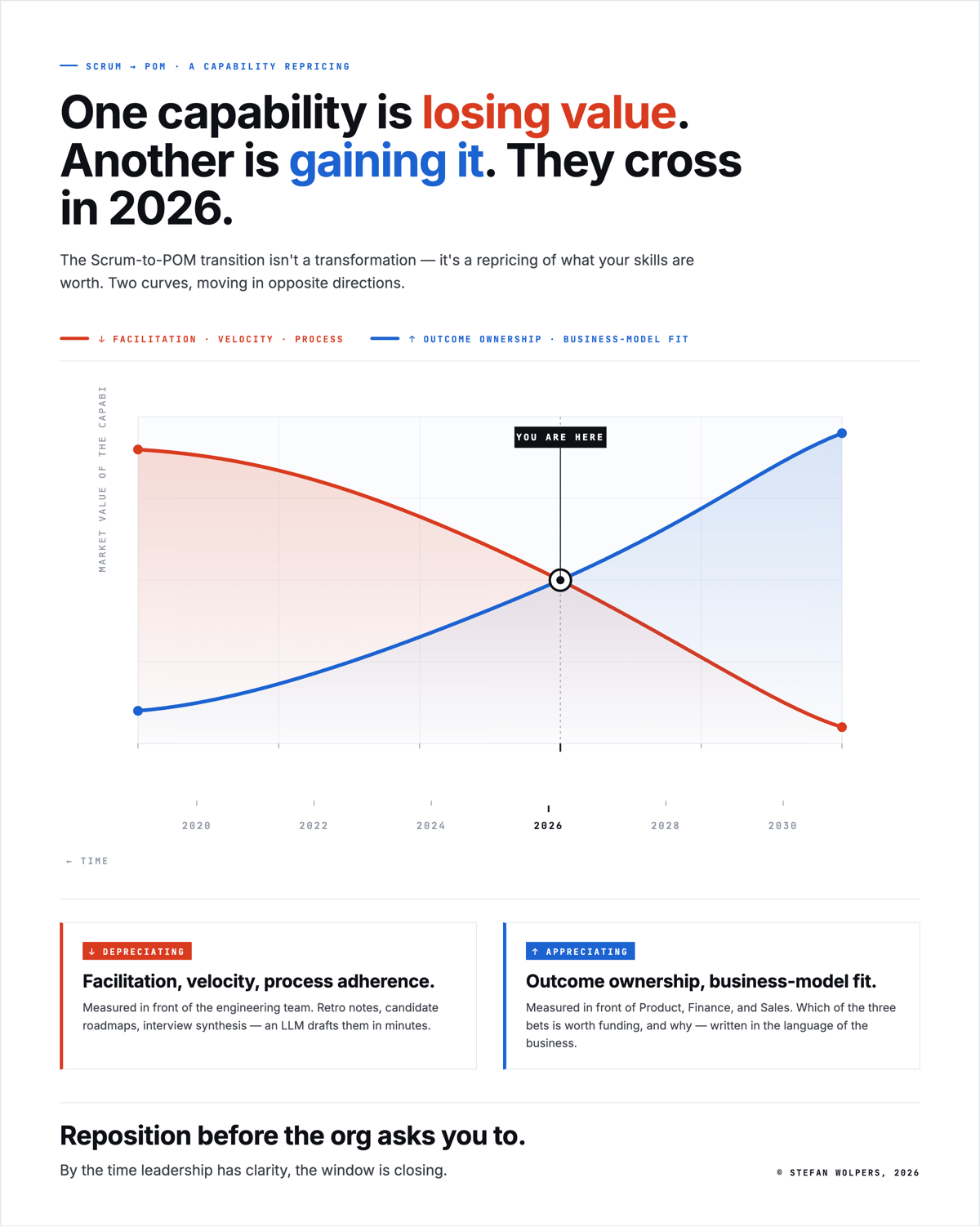
- The capability declining in value is facilitation, as measured by velocity and process adherence in front of the engineering team.
- The capability rising in value is outcome ownership measured by customer retention and business-model viability in front of the Head of Product, Finance, and Sales.
If your current week is built around the first and not the second, that is your gap.
The respondent who asked what a product coach actually is was asking the right question. A Product Coach, done properly, is an internal management consultant with an agile operating model as their home discipline. They are paid to help the organization answer “are we building the right thing” rather than “are we building the thing right.” That shift is the whole reposition in one sentence.
Waiting for organizational clarity is what got project managers caught in 2013. Hence, your 2026 tactic should be different: Reposition yourself before the org asks you to, because by then the window is closing.
Cannot see the form? Please click here.
Three Moves For This Week
No framework. No maturity model. Three things you can actually do between now and Friday:
- Audit your current role against what a Product Coach does: Ignore the marketing definition, consider your actual work. If your organization already has product coaches, watch them for a day. If it does not, read two job descriptions for “Product Coach” or “Principal Product Manager” roles at companies two stages ahead of yours and map them against your current week. The gaps are your repositioning backlog. If the audit produces no uncomfortable entries, you probably did it wrong.
- Pick one capability close to your current work where you can become demonstrably stronger in ninety days: Prioritize: Not five capabilities. One. If you pick P&L literacy, your Monday move is to ask your Head of Product for the unit economics of the product line you support, then read them until you can explain gross margin to a Developer. If you pick AI-assisted discovery, your Monday move is to take the last two user-research synthesis documents your organization produced and redo them with an LLM, then compare where the interpretation differs. Pick the adjacency that matches your actual interests, not the one that sounds impressive on LinkedIn. Pick one, not three, and move fast.
- Stop waiting for organizational clarity: The respondents who seemed most stuck were the ones waiting for leadership to tell them what the new role looked like. Leadership, in most cases, does not know either. The practitioners who come out of repricing events with stronger positions are the ones who made a bet on a direction and built visible proof of work before the org chart caught up. Visible proof of work is not an AI-generated discovery synthesis. An LLM can produce that in ten minutes, and your Head of Product can run it themselves. Visible proof of work is your interpretation of which of the three product bets the synthesis surfaced is worth funding, and why, written in the language of the business. That is the part the model cannot do from inside the discovery.
Why AI Is Not Another Buzzword
You are right to be suspicious. On a page telling you to stop waiting for better buzzwords, “AI fluency” would be the ultimate buzzword if it named one more capability to stack onto a resume full of them. That is not what is happening.
AI is a deflationary force on the production side of agile facilitation. An LLM can draft a Sprint Retrospective summary, propose a candidate roadmap, and synthesize user interviews in the time it takes you to read this paragraph. Practitioners who made their living producing those artifacts are watching the price of their hour-long facilitation get repriced toward zero, because a competent Developer, Product Manager, or Head of Product can now do most of that production themselves with a prompt.
What does not get repriced is the interpretation layer: Which of the three patterns the LLM surfaced in the Retrospective is the one the team is actually avoiding? Which of the five roadmap bets has a business model problem that the synthesis missed? What the missing user interview would have told you. That is the Product Coach move. That is the appreciating asset, the capabilities that grow in value.
AI4Agile is where I teach how to work inside that repricing. It is not a course about prompt templates. It is about recapturing the margin on your time so you can spend it on the interpretation layer the POM transition actually needs.
Scrum-to-POM — Conclusion: What I Want You to Sit With
If you had to describe the capability you will be demonstrably strong in eighteen months from now, in one sentence, using no buzzwords, could you do it?
If the answer is no, that is the work ahead of you. Chop chop, get to work.
Scrum-to-POM: Related Articles
Why Leaders Believe the Product Operating Model Will Succeed Where Agile Initiatives Failed
Product Washing: The Pitfalls of a Superficial Product Operating Model Transformation
Stop Telling Professionals How to Do Their Job — Commander’s Intent at Work
Three Thinking AI Skills to Sharpen Judgment
👆 Stefan Wolpers: The Scrum Anti-Patterns Guide (Amazon advertisement.)
Scrum-to-POM: Infographic Competition
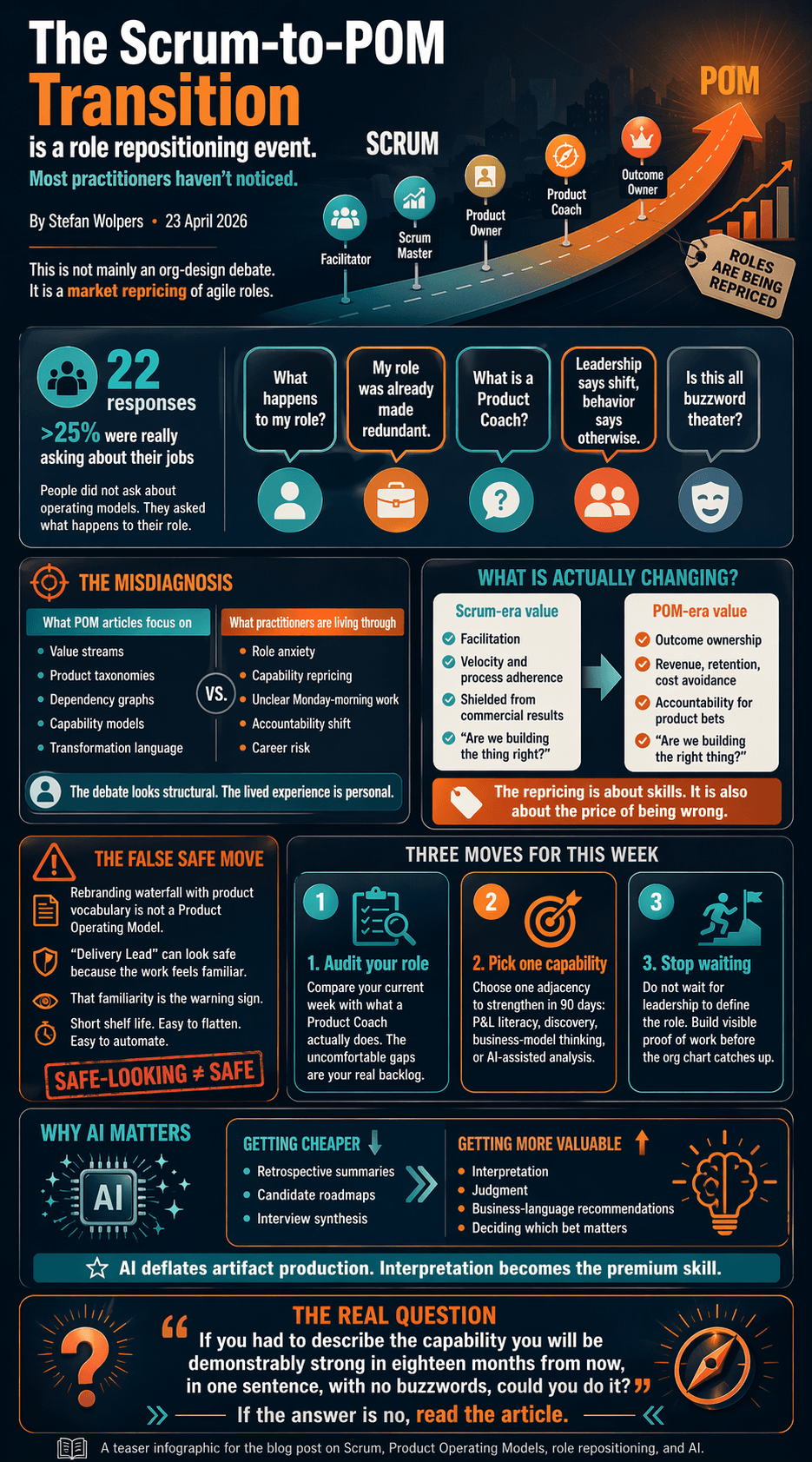
I ran a small competition between GPT Image 2.0 and Claude Design to create a meaningful infographic from this Scrum-to-POM article (minimal instructions and context; just from the text). Which one do you consider superior? Share with me in the comments.
GPT Image 2.0
Claude Design
📅 Training Classes, Workshops, and Events
Learn more about Token Economics with our AI and Scrum training classes, workshops, and events. You can secure your seat directly by following the corresponding link in the table below:
| Date | Class and Language | City | Price |
|---|---|---|---|
| 💯 🇩🇪 May 19-20, 2026 | GUARANTEED: Professional Scrum Product Owner Training (PSPO I; German; Live Virtual Class) | Live Virtual Class | €1.299 incl. 19% VAT (If applicable.) |
| 💯 🇬🇧 May 28 to June 25,2026 | GUARANTEED: AI4Agile BootCamp #7 — May 28 to June 25,2026 (English; Live Virtual Cohort) | Live Virtual Cohort | €499 incl. 19% VAT (If applicable.) |
| 🖥 💯 🇬🇧 June 1,2026 | GUARANTEED: Claude Cowork: Stop Prompting. Start Delegating. (English; Self-paced Online Course) | Self-paced Online Course | $129 incl. 19% VAT (If applicable.) |
| 🇩🇪 June 30 to July 1, 2026 | Professional Scrum Product Owner Training (PSPO I; German; Live Virtual Class) | Live Virtual Class | €1.299 incl. 19% VAT (If applicable.) |
| 🖥 💯 🇬🇧 July 1,2026 | GUARANTEED: AI 4 Agile Course v3 — Master AI for Agile Practitioners (English; Self-paced Online Course) | Self-paced Online Course | $149 incl. 19% VAT (If applicable.) (Before: $249, incl. Update to v3.) |
See all upcoming classes here.

You can book your seat for the training directly by following the corresponding links to the ticket shop. If your organization’s procurement process requires a different purchasing approach, please contact Berlin Product People GmbH directly.